


The Science Behind HEPA Filtration: What 99.97% Really Means
|
|
Tiempo de lectura 8 min
¿Tienes una cuenta?
Inicia sesión para finalizar tus compras con mayor rapidez.

|
|
Tiempo de lectura 8 min
Introduction
Air quality matters, whether you’re running a manufacturing facility, a warehouse, a restoration project, or a commercial cleaning service. When airborne dust, debris, or contaminants linger, they don’t just settle, they circulate, infiltrating ventilation systems, landing on surfaces, and posing risks to equipment, finishes, or human health. That’s where HEPA filtration comes in. But what does it really mean when a filter claims “99.97%”? In this post, we break down the science behind HEPA filter technology so you can understand why “99.97%” isn’t just marketing jargon, it’s an industry-tested baseline.
HEPA stands for High Efficiency Particulate Air. It’s not a marketing buzzword, it’s a well-defined standard that traces back to rigorous testing protocols established by regulatory and scientific bodies.
A true HEPA filter is engineered to deliver a minimum performance threshold: it must capture at least 99.97% of airborne particles at a certain particle size under standardized testing conditions.
Filters that meet this standard are dramatically more effective than ordinary or “HEPA-type” filters, which may lack testing or fall short of that efficiency.
The "99.97%" standard for HEPA filters is tied to a specific particle size: 0.3 microns (µm) in diameter.
Why 0.3 µm? Because this size corresponds to the so-called Most Penetrating Particle Size (MPPS) — the particle diameter that is hardest for the filter to capture.
In other words: if a HEPA filter can remove 99.97% of 0.3-micron particles, it will typically perform equal or better for particles both larger and smaller than that — making “99.97% @ 0.3 µm” a worst-case benchmark rather than a rounded guarantee.
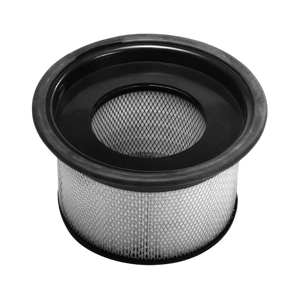
HEPA filters are not like simple mesh-screens or rigid sieves. Instead, they rely on a dense, randomly arranged mat of fine fibers (often fiberglass or polypropylene) through which air is forced.
As air passes through:
Larger particles get blocked by direct interception — like a sieve catching larger debris.
Mid-sized particles — especially around the MPPS — may be diverted, bounce off fibers, or slow down enough that they hit a fiber and adhere (impaction & interception).
Very small particles move erratically (Brownian motion), diffusing through the air and colliding with fibers — often sticking due to electrostatic attraction or contact (diffusion & interception).
The net result: a multi-mechanism trap that captures particles across a wide size range — from visible dust down to microscopic allergens, mold spores, or even some bacteria.
Benchmark vs. baseline: The 99.97% rating is the minimum efficiency required under test conditions at the 0.3 µm MPPS. In reality, a true HEPA filter may perform better for other particle sizes — often well above 99.97%.
Particle load vs. airflow: Efficiency assumes correct airflow/restraint conditions. Overloading a filter or improper maintenance can degrade performance. That’s why proper maintenance and timely filter replacement matters.
Limitations exist: HEPA filters target particulate matter, not gases or chemical vapors. For volatile chemicals, odors, or gases, additional filtration (e.g., activated carbon) or air-scrubbing techniques may be needed.
Real-world impact: For facilities, using real HEPA — not just “HEPA-type” — filtration dramatically reduces dust, mold spores, pollen, and a wide range of fine particulates. This means cleaner air, fewer allergens, less dirt recirculation — and a healthier environment for both people and equipment.
|
Myth / Misconception |
Reality — What You Should Know |
|
“HEPA” = “any filter labeled HEPA works equally well.” |
Only filters meeting the formal standard (99.97% @ 0.3 µm) qualify as true HEPA. “HEPA-type” or “HEPA-lite” filters often don’t guarantee that efficiency. |
|
0.3 microns = smallest possible particulate captured |
Actually, HEPA often works better for smaller particles — the 0.3 µm is the hardest to capture (MPPS). |
|
Once installed, HEPA filter works forever |
Filter performance degrades over time. Dust load, airflow volume, and maintenance intervals all affect real performance. Regular replacement per manufacturer specs is critical. |
|
HEPA removes odors, gases, chemicals |
HEPA captures particles, not gases or volatile organic compounds. For chemical vapors or odors, additional filtration methods are needed (e.g., activated carbon, chemical scrubbers). |
For a brand like Mastercraft®, which serves industrial, commercial, and restoration markets, understanding the true science of HEPA filtration is essential. Here’s why:
Protect sensitive environments: Dust, mold spores, and fine particulates — especially in large facilities, warehouses, or manufacturing plants — can damage equipment, clog ventilation, and undermine air quality. HEPA-equipped vacuums and filtration systems dramatically reduce these risks.
Health & safety compliance: Many commercial or institutional spaces (clean rooms, labs, hospitals, restoration sites) require true HEPA filtration to meet air-quality and safety standards. Using certified HEPA filters ensures compliance and occupant safety.
Longevity of infrastructure: Fine dust and particulate matter are abrasive and corrosive over time, damaging floors, HVAC systems, and sensitive machinery. By capturing these particles at the source, HEPA filtration extends the lifespan of building assets.
Real value vs. “marketing filters”: Investing in true HEPA filtration — rather than generic “HEPA-type” filters — represents a commitment to quality, performance, and long-term savings. It aligns with Mastercraft’s ethos: cleaning isn’t a commodity, it’s a critical infrastructure. (Just like in our winter-prep blog, where we argued that proper filtration is a non-negotiable investment.)
Mastercraft® integrates true HEPA filtration across several product categories, with the Environmaster series standing out as the company’s flagship HEPA solution for demanding environments. Mastercraft’s HEPA-equipped machines include:
Environmaster® HEPA Wet/Dry Vacuums
Designed for heavy-duty commercial and industrial use, these vacuums feature:
Certified True HEPA filters meeting the 99.97% @ 0.3 µm standard
Sealed filtration pathways that prevent leakage or particle bypass
High-performance motors maintaining strong suction even through dense HEPA media
Durable stainless steel or high-impact tanks built to withstand harsh environments
Applications include:
Mold remediation
Construction debris removal
Water damage restoration
Hazardous particulate containment
Facility maintenance requiring strict air quality control
Multi-Stage Filtration:
EnvironMaster® equipment integrates a multi-stage approach for maximum efficiency:
Pre-filter to trap large debris and extend HEPA lifespan
Secondary filter for fine particulates
True HEPA final stage, capturing 99.97% of the most penetrating particles
This system ensures stable airflow and sustained HEPA performance in high-load applications.
Engineered for Compliance & Safety
Mastercraft’s HEPA technology supports:
EPA standards for particulate control
OSHA requirements for certain dust hazards
Industry protocols for restoration and remediation environments
By using rigorously tested HEPA components, EnvironMaster® equipment delivers the reliability professionals depend on when air cleanliness cannot be compromised.
“HEPA” stands for High Efficiency Particulate Air — a scientifically defined standard, not a marketing catchphrase.
The “99.97%” refers to a filter’s minimum efficiency at capturing 0.3 µm particles — the hardest size to catch. At other sizes, efficiency is typically equal or better.
Multiple physical mechanisms (interception, impaction, diffusion) work together to trap particles across a broad size range.
For industrial, commercial, or professional cleaning scenarios, true HEPA filtration matters — it delivers real air-quality improvements, protects infrastructure, and ensures compliance with safety standards.
When choosing cleaning or vacuum equipment, prioritize products that use certified HEPA filtration, maintain them properly, and replace filters on schedule.
At Mastercraft®, we believe critical filtration isn’t a commodity — it’s a commitment. If you care about air quality, long-term facility maintenance, and protecting people or equipment from fine dust, allergens, or contaminants, HEPA shouldn’t be optional. It should be standard.
Here are answers to common questions about HEPA filtration and what “99.97%” really means in professional cleaning and restoration.
The 99.97% rating means a true HEPA filter has been tested and proven to capture at least 99.97% of airborne particles measuring 0.3 microns in diameter under standardized conditions. Because 0.3 µm is the most penetrating particle size, actual performance at other particle sizes is typically equal or even better.
Particles around 0.3 microns are known as the Most Penetrating Particle Size (MPPS). They are the hardest for filters to capture because they sit in a transition zone between interception, impaction, and diffusion. If a filter can reliably remove 99.97% of these particles, it will typically capture both larger and smaller particles even more efficiently.
True HEPA filters are tested and certified to capture at least 99.97% of 0.3 µm particles. “HEPA-type” or “HEPA-like” filters may look similar but are not required to meet this strict standard. They often provide lower and inconsistent efficiency, which is not acceptable in professional environments where air quality and compliance matter.
HEPA filters are designed to capture particles, not gases. They remove dust, mold spores, pollen, and fine debris, but they do not neutralize odors or chemical vapors by themselves. For VOCs, fumes, or smells, HEPA is often paired with activated carbon or other gas-phase filtration media as part of a complete system.
There is no single replacement interval that fits all applications. In light-duty environments, HEPA filters may last longer, while in industrial, commercial, or restoration work they load quickly due to higher dust levels. The best practice is to:
Proactive replacement ensures your system continues to meet true HEPA performance standards.
In industrial and commercial facilities, fine dust, debris, and contaminants don’t just settle—they circulate through HVAC systems and land on equipment, floors, and work surfaces. True HEPA filtration helps:
For professional cleaning, choosing true HEPA is a strategic investment, not a luxury.
Mastercraft® integrates certified true HEPA filters into its EnvironMaster® HEPA wet/dry vacuums and related equipment. These machines feature:
This combination delivers reliable, certified HEPA performance for mold remediation, construction cleanup, water damage restoration, and facility maintenance where air cleanliness cannot be compromised.


